Natalya Guerrier: A Surprise Wedding NICU Story
January 5, 2026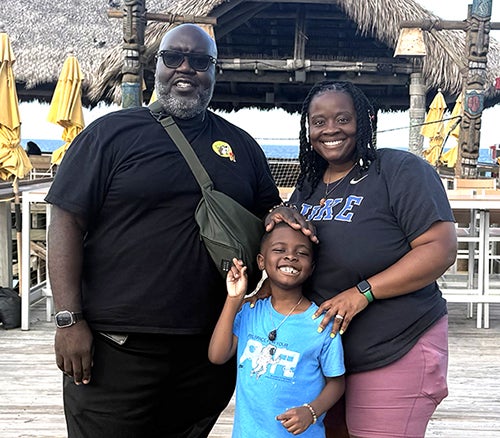
By: WakeMed Children's Hospital
Categories: Women's, Children's, Raleigh Campus, Spiritual Care, Stories, Foundation, Pregnancy
Tags: hydrocephalus, Walker-Dandy Syndrome, Cerclage, Maternal Fetal Medicine
Natalya Guerrier and her fiancé had been trying for quite some time to become pregnant. With each negative test, they grew more despondent that parenting may not be part of their story.
However, one day after missing her period, Natalya decided to quietly purchase a pregnancy test.
"I didn't have any symptoms other than my late period. Every time I'd previously taken a test, it came back negative, so I didn't want to stress over it. I went to a dollar store and purchased two inexpensive tests. To my surprise, they both came back positive."
Natalya alerted her fiancé of the amazing news and at five-and-half weeks pregnant, she began her schedule of obstetrics visits.
Cervical Support to Maintain the Pregnancy
Natalya received care from Carmen J. Beamon, MD, MPH, FACOG, of WakeMed Maternal Fetal Medicine. Due to some issues with her cervix, Dr. Beamon recommended a cervical cerclage procedure to stitch up the mouth of Natalya's uterus to prevent miscarriage or premature birth.
"I had the cerclage because by five months pregnant, I was already dilating."
Navigating a Fetal Diagnosis
Around that same time, the couple received the incredible news that they were having a baby boy. Natalya also underwent amniocentesis, where she received the heartbreaking news that her son had Dandy-Walker syndrome.
Dandy-Walker syndrome, often referred to as Dandy-Walker malformation, Dandy-Walker or hydrocephalus, is a congenital brain condition that affects the development of the brain. The condition is present at birth, arising during the early stages of fetal development in the womb. The syndrome is characterized by an enlargement of the fourth ventricle, a cystic enlargement of the posterior fossa, and an absence or underdevelopment of the cerebellar vermis, which can lead to various neurological issues. As a result, babies with Dandy-Walker syndrome may experience a range of symptoms, including developmental delays, coordination problems and increased intracranial pressure. Understanding this condition is crucial for early diagnosis and intervention, which can significantly improve the quality of life of affected babies.
"The five-month mark appointment was a whirlwind and emotional roller coaster. It was filled with sad moments. We were asked to consider terminating the pregnancy since our son's condition could lead to him being a vegetable. When we were offered the option to abort, we simultaneously said, 'No.' We hadn't consulted each other, but we had awaited this baby for so long and both knew God had a bigger plan for our son."
Once the couple determined they would move forward regardless of the outcome, Natalya settled into her pregnancy and began to feel joyful, despite the unknown.
"I was glowing. My hair and nails grew. I slept a lot. It was a normal, happy pregnancy."
Braxton-Hicks, Urinary Tract Infection or the Real Deal
On March 9, 2018, around the 32-week mark, Natalya began having contractions. Her mother and aunt were in town for her baby shower the next day, so her fiancé sped her to the hospital with her mom and aunt in tow.
Natalya was diagnosed with a urinary tract infection, was prescribed medication and was sent home. Her mom informed her that it was likely Braxton Hicks contractions, so they relaxed and prepared for the baby shower.
"I was having contractions on March 10, the day of my baby shower, but I still had my hair done in preparation for my shower. It was my first baby, so I didn't know what real contractions were like. At the baby shower, I had to take a pause every few minutes because I was having severe contractions. We had a lot of people come into town, and I didn't want to disappoint them. Before long, I couldn't handle the pain, and I went home with my mom. My fiancé remained at the shower to entertain our guests."
On Sunday, Natalya called the WakeMed Obstetrics & Gynecology - High Risk – New Bern Avenue nurse's line and informed them she was having severe cramping and contractions. Since she was high-risk, they urged her to go to the hospital. The family returned to WakeMed Raleigh Campus Emergency Department, and she was admitted. The team worked hard to prevent delivery since she was eight weeks early.
"They didn't want to deliver my baby because I was so early and preferred to do a steroid shot to delay delivery."
Steroids, particularly tocolytics, are drugs given to women experiencing early signs of labor to help slow down or even halt uterine contractions. These medications aim to postpone labor for a few days, providing crucial time for further development of the fetus and for the mother to receive any necessary medical treatment.
"I didn't know how much longer I could endure the pain though. I was only able to get one steroid shot to help stall my symptoms. They then removed the cerclage to redo the procedure and reinforce it to give my son more time in utero, but as soon as they removed the cerclage, my water broke."
An Unexpected, Yet Happy Delivery
Of the experience, Natalya recalls delivery being a blur.
"I had an epidural after my water broke, so I didn't feel my contractions anymore. A nurse had to tell me when to push. My fiancé was next to me wearing scrubs. The delivery room was a bright white with numerous doctors and nurses caring for me and being so welcoming. I pushed a little and then he came out face up. They asked me if I wanted to touch my son before they rushed him to neonatal intensive care (NICU). I touched him briefly and felt an instant rush of love."
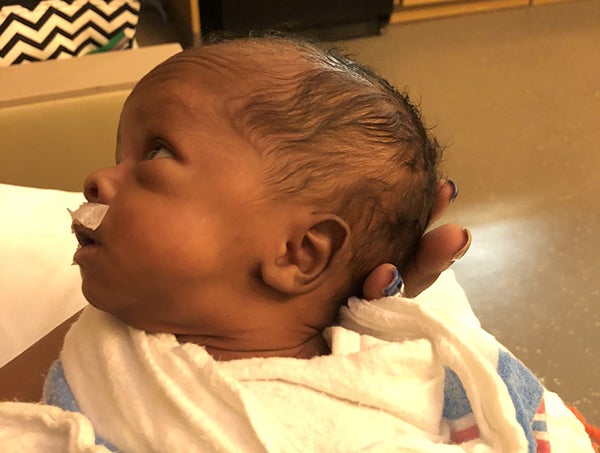
Baby Tre' Lewis was born on March 11 around 7 pm with the skilled guidance of a resident with oversight from attending WakeMed obstetrician gynecologist Jenna Beckham, MD, MSPH, FACOG, FACS. He weighed five pounds.
"I remember eventually getting to hold him for the first time and then smelling him. He smelled so good. I counted his fingers and his toes. My child's father had left to go handle some things at home. I video called him, and our son had his eyes open. we joked that our son had been here before. He was so calm and not crying. He was looking around."
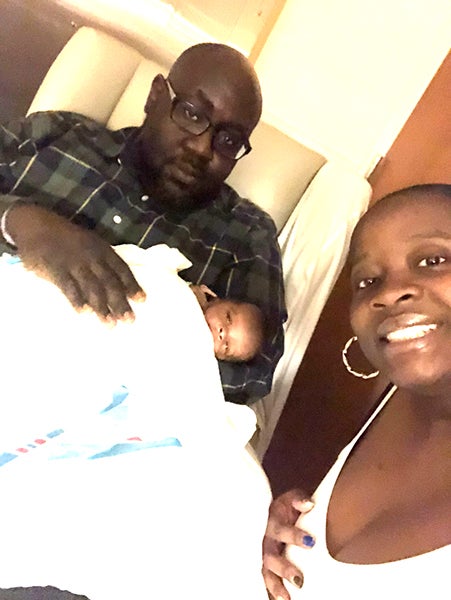
The couple cooed over their beautiful baby, both with tears of joy, and rested in the kind care of their WakeMed team who worked hard to provide the highest quality care to Natalya — during postpartum as well as care for their newborn son who had hydrocephalus.
A Surprise Wedding
"I remember telling a nurse that we'd planned to surprise my mom and aunt with a wedding after my baby shower. I wanted a courthouse wedding, but our baby came unexpectantly, so we would leave the hospital without being married. I was also a little sad that my mom and aunt had to leave prior to the birth because of a snowstorm that was coming to the area."
Moments later, to Natalya's surprise, her nurse returned to her room and asked a question: "How do you feel about getting married at the hospital, so you can all leave with the same last name?"
Natalya was pleasantly shocked. I asked her, "What are you talking about?"
The same day, a WakeMed Spiritual Care Chaplain met the couple in the hospital chapel to perform their wedding ceremony — with Natalya's soon-to-be mother-in-law as the witness. Natalya dressed nicely and fashioned her hair. The nurses made a wedding bouquet of paper flowers.
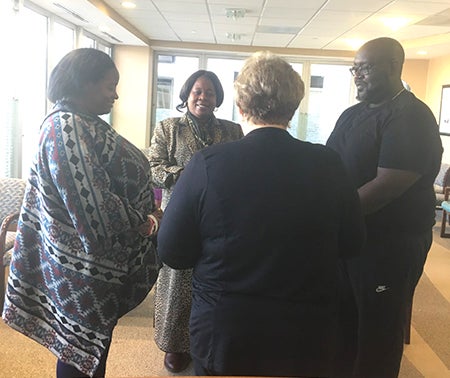
Natalya glows recalling that moment. "I still have the flowers. The nurses provided vows for us. They sang. After the ceremony as we were going back to my postpartum room, the nurses were clapping and cheering for us."
The couple left the hospital, following Natalya's discharge that day, and they took their marriage certificate to the courthouse as well as their son's birth certificate to be updated with his father's last name. They renamed their son Harry Guerrier, III, and affectionally nicknamed him Tre'.
State-of-the-Art Care for a Precious Baby
Tre' remained in the WakeMed NICU for three weeks. After three weeks, a WakeMed neonatologist delivered news with tears in her eyes that they would need to transfer their son to a different hospital system to receive a ventriculoperitoneal (VP) shunt.
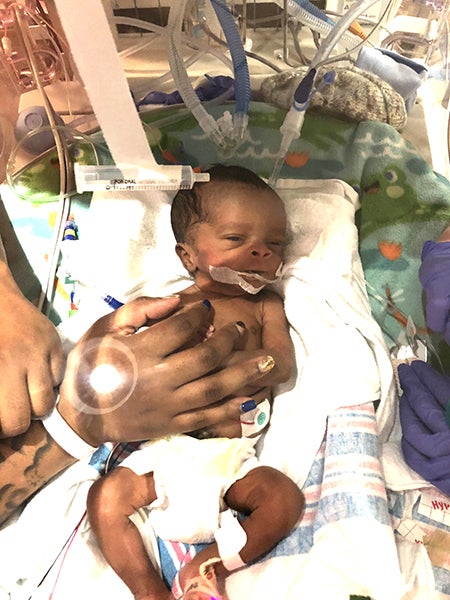
"I was crushed," shares Natalya. "She told us that fluid was growing rapidly in his brain based on his latest scans. We were scheduled to go home just a few days later, and the news meant we'd be starting over at another NICU. Instead of having a joyful moment, our son was transported via ambulance to the new NICU. My husband and I followed behind in our car."
Baby Tre' had shunt placement and remained in the hospital for two weeks. A doctor at that hospital fought for the couple to be admitted to the Ronald McDonald house since they were driving from their home in Wake County to the hospital in Durham County. This helped Natalya be present with her son as he recovered from surgery and prepared to go home.
A Family Blessed with Love and Health
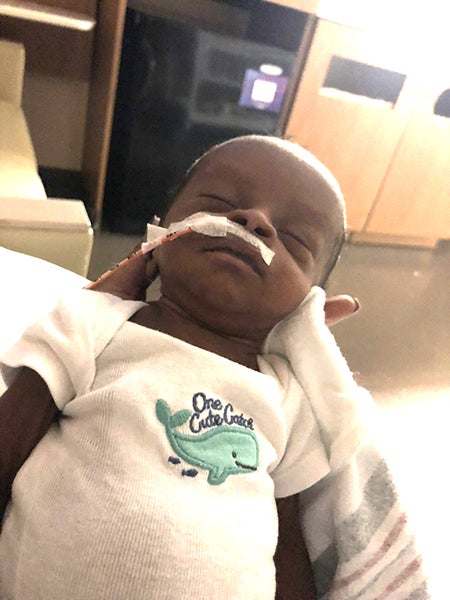
The couple finally took their son home in late April 2018.
"He had been struggling to maintain his weight, but soon after we got him home, he began to gain weight. He was in a loving environment. He was happy to be home. Doctors were amazed by his progress. Unfortunately, he developed seizures in the toddler years, which caused him some left-side weakness, so he is currently in occupational therapy, but it has been four years now since he's had a seizure. Doctors thought he'd be a vegetable, but today our son is seven years old, and he is like any other boy his age. He loves math and video games. Tre' beat the odds. We can't thank our WakeMed team enough for their love, compassion and care. We give God glory for giving us a healthy child."

About WakeMed Women's
Our multidisciplinary team of maternal fetal physicians, genetic counselors, sonographers and nurses provides a wide range of specialized services for women who have a high-risk pregnancy. You can rely on the expertise and experience of our team — which includes 9 board-certified Fetal Echocardiography sonographers — to provide you the best quality care. This includes women who are at increased risk for genetic disorders due to advanced maternal age or family history, women who are experiencing or have a history of pregnancy complications and women with preexisting medical conditions that might adversely affect a pregnancy outcome.
In pregnancy and childbirth, we care for you and your baby in an environment designed for the needs of pregnant women. Our around-the-clock specialty trained care teams are here to walk alongside you each step of the way.
We offer exceptional quality in all three of our birthing centers.
About WakeMed Level IV NICU
WakeMed’s highly specialized Level IV Regional NICU offers:
- 48 patient beds, including 27 single private rooms and eight rooms that accommodate multiples (twins and triplets)
- Full-time neonatologists – Specialists in the care of critically ill babies
- Full-time perinatologists – Specialists in treating high-risk pregnancies
- A team of neonatal, pediatric and family practice nurse practitioners
- Highly skilled neonatology staff, including pediatric psychologists, child development specialists, speech-language pathologists, registered nurses and PhD-level physical therapists
- Lactation consultants
- WakeMed Mother’s Milk Bank – Direct access to one of the few human milk donation programs in the country and the only one in the southeast
- Special Infant Care Program for outpatient follow-up
- Special neonatal delivery team
- Dedicated neonatal respiratory therapists