When the Healer is Healed: Skip Roy's WakeMed Legacy
June 29, 2026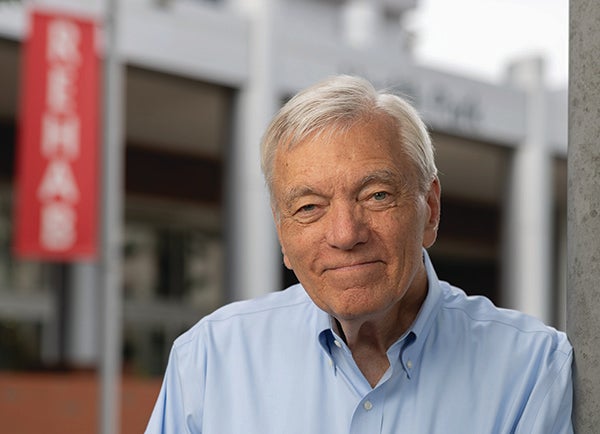
"What attracted me to WakeMed in the 1970s was the commitment to care for all patients. Back then, if you were a person of color or poor, you were rejected for care at many hospitals, but WakeMed welcomed all, and we gave great care because we cared about you before we cared for you."
A Career Built on Compassion
Skip worked for WakeMed for 52 years in various roles. He joined, initially, as a therapist. He eventually became the manager of acute rehabilitation in Raleigh and then in Cary as well.
"What kept me going was working with a team who deeply cared about people. When we interviewed potential hires, we paid attention to their values. We could teach clinical skills. We needed to understand if candidates operated with compassion, tenacity and integrity. Therapy, in particular, requires care team members who believe if plan A for a patient doesn't work, instead of giving up, they move to plan B or even C because at the end of the day, we want patients to be well."
A Patient Experience That Proved It Worked
Skip not only had the opportunity to work for WakeMed, but he was on the receiving end of the exceptional care. He was born with a congenital heart murmur. That combined with a family history of serious heart conditions, Skip approached a WakeMed cardiologist for support in monitoring his heart health.
"I told him that I can't run away from my family history, so we started doing stress tests every year just to keep an eye on things. The doctor passed away sadly. That's when I met cardiologist Marc Silver, MD, who has been great. For the last six years, he has provided echocardiograms every other year."
Skip's proactive approach paid off. For years as his heart deteriorated, the condition remained silent. He had no symptoms. In fact, he ran 10 full marathons and some half marathons. In February 2026, he began noting symptoms of an ache between his shoulder blades when going uphill.
Skip visited Dr. Silver to rule out a heart issue. Dr. Silver performed an echocardiogram and found that Skip needed an aortic valve replacement for aortic valve stenosis.
Dr. Silver explains, "Since Skip had discomfort between his shoulder blades that would resolve with rest and reoccur with exertion, this alerted me to a potential sign of progressive aortic stenosis."
Taking care of all patients is a privilege. Restoring someone to a great quality of life is why I go to work every day and why I can't imagine ever fully retiring."
On March 3, he was admitted for a cardiac catheterization at the Heart Center, where he first received a pacemaker after finding an arrythmia at the time of his cardiac catheterization. He was next scheduled for a minimally invasive transcatheter aortic valve replacement (TAVR) on March 17 to treat his aortic valve regurgitation, resulting from his valve failing to close properly. The TAVR would replace his narrowing aortic valve that was preventing proper blood flow to other parts of his body.
"It was totally a God thing. First, I prayed that cardiovascular surgeon Byron Bolton, MD, and structural heart surgeon Andrew Sampson, MD, wouldn't have to open my chest. The echocardiogram showed a bicuspid aortic valve, two leaflets instead of three, which shaped the valve differently. Most of the time with bicuspid aortic valves, open heart surgery is required, but both doctors confirmed that the TAVR was a perfect fit, so instead of four days in the hospital after a five-hour open heart procedure, I would have a brief procedure and go home soon after. Next, in cases like mine, they sometimes need to place a stent prior to the procedure, which would delay it by a month. Because the aortic valve dysfunction was evidenced beforehand, they were able to install a pacemaker, which meant my TAVR was scheduled days later. The surgeons told me it was a huge benefit that the arrythmia declared itself before the TAVR, so they could put in the pacemaker, making the TAVR a far less complex procedure."
How Skip's TAVR was Performed
During his TAVR, Dr. Boulton and Dr. Sampson replaced the malfunctioning aortic valve with a new one made from cow heart tissue. His TAVR was performed through small incisions using a catheter inserted into a blood vessel in Skip's groin. The doctors navigated it to his heart's aortic valve with the help of X-rays. Once in position, the new valve was delivered through the catheter and placed next to the old valve, where a balloon at the catheter's tip expanded to secure it in place. After ensuring the new valve was firmly positioned, the doctors removed the catheter, all while the care team closely monitored Skip's vitals, including blood pressure, heart rate and breathing.
Individualized Care that Put the Patient First
The day of Skip's TAVR, he received exceptional care, and he awoke from the procedure in minimal pain from two IV placements, not the procedure. To ease his discomfort, they removed one of his IVs.
"The staff was amazing. Lynn Boyd, the structural heart nurse, was exceptional. The procedure took about 45 minutes, and I only spent one night in the hospital. I could have gone home the same day, but they wanted to perform an echocardiogram the following morning to ensure the valve was working properly. They did it early on March 18, so I got home in time to attend Lent at my church that evening."
Skip was especially impressed with the individualized approach to the care he received.
"The nurse was scheduled to check my blood pressure every 15 minutes all throughout the night, but since I was doing very well, and I wanted to sleep, she spread out the checks, so I could get some rest. Nurses also were excellent with sharing information for shift changes. I felt a complete continuity of care. The morning of my discharge, I was very hungry. The care team shared a variety of breakfast options. That breakfast beat the heck out of the bowl of cereal I usually eat at home. It's worth a visit to the hospital just to enjoy breakfast. Last, before I left the hospital, they allowed me to use a stethoscope to listen to my heart. I was happy to hear no more murmur."
A Short and Effective Cardiac Rehab Experience
Within days of returning home, Skip scheduled with WakeMed Cardiac Rehab. He attended classes for a couple of weeks, finishing April 10.
"I shared my goals with the exercise physiologists and dietitians to run safely without bizarre cardiac arrhythmia problems, to explore a heart healthy diet and, last, to prevent falls through strength training. The team was great in helping me achieve my goals."
Back Up and at 'Em
Today, at 80 years old, Skip is back to enjoying his morning runs. He also volunteers at WakeMed to support patients and travels abroad for medical mission trips to help the less fortunate.
About WakeMed Cardiac Rehab
At WakeMed, cardiac rehab isn’t just about recovery – it’s about rediscovering confidence, gaining strength and knowledge to live a heart-healthy life. Our program is tailored for those recovering from cardiac events such as a heart attack, heart surgery (including bypass or valve repair/replacement), angioplasty or stent placement, heart failure or stable angina. Whether you join us in person or virtually, our expert team guides every step of your journey.
About WakeMed Heart & Vascular
WakeMed Heart & Vascular physicians bring together expert cardiologists along with cardiovascular, thoracic and vascular surgeons who are dedicated to delivering the highest level of cardiovascular care in Raleigh, Apex, Benson, Cary, Dunn, Fuquay-Varina, Garner, Morrisville, Wake Forest and Clayton, N.C. For decades, these physicians have chosen to bring their talent and expertise to WakeMed for its reputation for excellence in cardiovascular care and commitment to providing the most exceptional patient experience.