Take 5 with WakeMed Cancer Care Oncologist Eric Olson, MD
October 6, 2025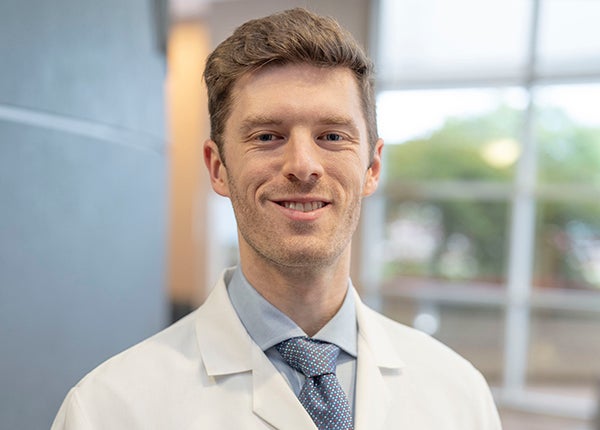
By: WakeMed Health & Hospitals
Categories: Cancer Care
Tags: meet the provider, Meet the Doctor, Oncology, Immunotherapy
We are excited to introduce Eric Olson, MD, as the latest addition to our team of oncologists at WakeMed Cancer Care – Hematology & Medical Oncology. Dr. Olson is fellowship trained in hematology and medical oncology, bringing a rich background and extensive expertise in the treatment of various cancers. His approach focuses on providing the most comprehensive and effective care possible, all while prioritizing quality of life for patients throughout their treatment journey. With his dedication and knowledge, Dr. Olson is poised to make a significant impact on our community, ensuring that each patient receives personalized and compassionate care tailored to their unique needs.
Get to know Dr. Olson and what drives his passion for oncology and exceptional care.
What led you to become an oncologist?
When I was in medical school, I knew I wanted to build lasting relationships with my patients and their loved ones. Being fully present with patients and families during the hardest moments of their lives is my most important responsibility as a physician. That in mind, the continuity of care I get to deliver to my patients in internal medicine is what drew me to this path.
When it came time to specialize, I loved oncology for the strong and lasting relationships forged with patients. I was also intrigued by the rapid advancement in the field and real-time acceptance of new and better treatment modalities. In fact, in my current practice as soon as I have sound evidence demonstrating more effective treatments, often with decreased side-effects, I can immediately implement them for my patients.
Why is this field important to you?
I learned at a young age the importance of the advancement of science and medicine. My father was diagnosed with Hodgkin’s Lymphoma when he was very young — around 13. Nowadays, it has about a 99 percent cure rate, but back then it was a death sentence. He participated in a clinical trial and was one of the first patients in the nation to go into remission. Because of this, he was able to have a family and go into remission two more times at ages 20 and 27. These new treatments and clinical trials turned what was a death sentence for so many patients into a highly curable condition with significantly decreased side-effects of treatment. This, to me, is the gold standard in medicine and what I hope to see in so many different fields within oncology.
What made you decide to join WakeMed Cancer Care?
I learned about WakeMed when I was in Winston-Salem completing my residency at Wake Forest Baptist Medical Center. Several of my colleagues shared the collaborative, multidisciplinary approach at WakeMed and how it had a great atmosphere. Understanding that WakeMed has always been known for exceptional care in medicine, I was excited to join a team that I respect so much. It is nice to be part of a group that is very dynamic and is dedicated to continuous improvement and delivery of the best possible care.
Tell us about your research. What interests you most?
Since the start of my internship, residency and fellowship training in hematology and oncology at Wake Forest Baptist Comprehensive Cancer Center, I have been part of a research group focused on optimizing immunotherapy usage. In a nutshell, immunotherapy is an umbrella term for a variety of treatments that utilize and enhance a patient's own natural immune system as a means of fighting cancer. It is arguably the most impressive recent innovation in the field of oncology and is being used to treat increasingly more cancer types.
I have delivered a variety of presentations and publications regarding different rare toxicities of immunotherapy, which can present as rare autoimmune conditions and am constantly examining ways of optimizing treatments to improve outcomes and decrease side-effects. I am passionate about delivering care in a way that decreases symptom burden and improves quality of life.
What specializations do you have for your cancer care patients?
I strive to make sure all my patients are aware of their diagnosis, treatment plan, side-effects and evidence for my plans. I am passionate about giving my patients the most advanced care and working with them to make sure they feel heard — giving them time to address their diagnosis and treatment challenges. I always encourage my patients to voice any concerns or side effects and ask questions regarding treatment, so I can best help them. I will often tell folks, "You don't get extra points for suffering in silence."
Some patients are terminally ill. My work is about making sure my patients not only live longer but also live better. At the end of the day, my mandate is to do no harm to my patients.
Additionally, because of my recent training at a National Cancer Institute designated Cancer Center. I'm very up to date on a diversity of treatments that other doctors may not have yet been exposed to. I'm very familiar with myriad advanced treatments, which we're using more and more in various cancers across the board.
What do you enjoy outside of work?
I have played tennis recreationally since I was about 10 years old after my mom got me into it. I try to play year-round. I enjoy swimming, weightlifting and am picking up golf — although I am nowhere near good yet. I have a Jack Russell Chihuahua mix named Chester, whom my wife and I adopted from a local shelter in Winston-Salem. We are obsessed with him. Even though I have lived all over the United States, I feel incredibly lucky that so many family members and friends live here in Raleigh, so I spend lots of time with them as well.