Steve Dunn's Nine-Year Search for Relief from BPH Ends with WakeMed Urology's Aquablation® Treatment
November 12, 2026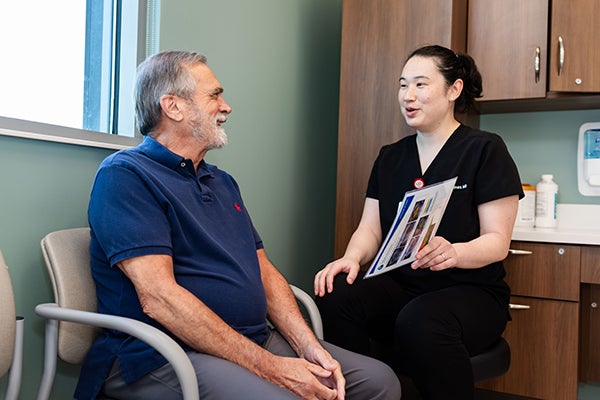
About nine years ago, Steve Dunn began experiencing difficulty emptying his bladder.
"I turned 70 in October, so I spent much of my 60s dealing with this issue."
A systems programmer for global Fortune 100 companies, he often worked more than 70 hours a week. His demanding workdays were frequently interrupted by the need to use the restroom.
"I had a hard-driving, high-strung job, and I needed sleep, which I wasn't getting," Steve shares. "My stream would start and stop. I'd go throughout the day and get up several times during the night; it wore me down."
An Unfortunate Diagnosis
Steve was diagnosed with benign prostatic hyperplasia (BPH), a condition common in older men, in which the prostate becomes enlarged, leading to frequent urination, weak urinary stream and difficulty starting urination.
For several years, Steve sought treatment from various doctors. His medications were repeatedly changed, and he was even told about a procedure that might help — only to later learn that he wasn't a candidate. One day, during a visit with his primary care doctor, she asked why he was taking a particular medication. When Steve explained that it was for BPH, she told him that it was not a commonly used treatment for men and was instead indicated for women. That conversation convinced Steve it was time to find a new medical group.
"I was being tossed around like a hot potato. I was totally fed up, so I Googled, 'Urologists in the triangle area with positive reviews.' Katy Reines, MD, of WakeMed Urology popped up. I read her reviews and asked my primary care doctor for a referral."
Hope for Help at WakeMed
Steve went to his first appointment with Dr. Reines at the Urology – Wake Forest Medical Park location nervous but hopeful. He remembers having bags under his eyes, feeling exhausted and worrying about the toll his ongoing urinary difficulties were taking on his bladder. As soon as he met Dr. Reines, his fears turned to relief.
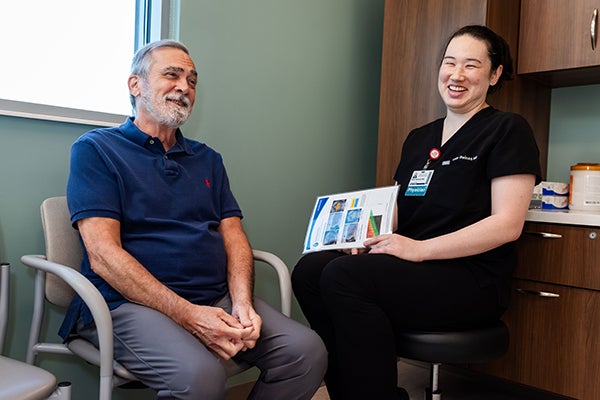
"I saw her on July 2, and it was the best urology appointment I've ever had. She explained treatment options in layman's terms. She was very open, so I felt relaxed and comfortable enough to express personal issues with her. I was thinking to myself during the appointment, 'Why didn't I see her 10 years ago?'"
Dr. Reines used a whiteboard to illustrate the various surgical options, making it easy for Steve to understand the differences. She also introduced a newer innovation: transurethral robotic-assisted water jet resection of the prostate — also known as Aquablation® therapy.
"I liked this idea the best, and I told her, 'I'll give it a shot.' She responded that they just acquired the machine at WakeMed that same day. While she had done the surgery many times, it would be the first for the hospital system," Steve comments.
Recognizing that the surgery was new to WakeMed, Dr. Reines asked Steve whether he was certain he wanted to proceed.
Exasperated, he recalls saying, "I need relief."
The Choice to Try a New Surgical Solution
Being approved for this surgery was no small feat. Over several weeks, Steve underwent three tests. If he failed all three, his insurance would cover the cost.
He was pleasantly surprised by how quickly his surgery was scheduled at WakeMed Raleigh Campus for August 14, but he still wavered between hope and nervousness.
"I was going to be put under general anesthesia. At my age, I knew this was a risk. Plus, while Dr. Reines was well versed in the surgery, it would be the first for her surgical team. My emotions were all over the place. Throughout it all, her team was so friendly and personable. Every person I encountered was compassionate and positive."
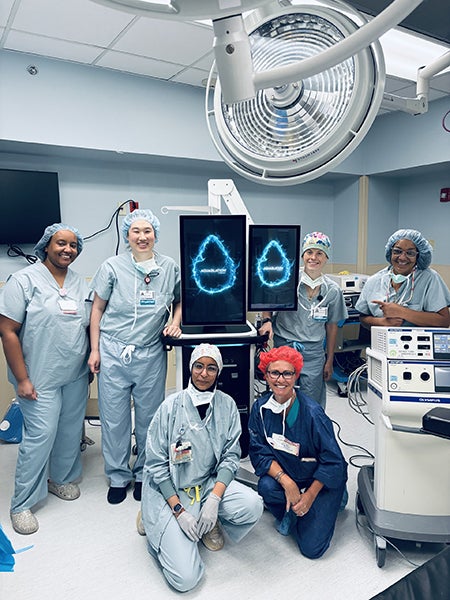
The day of surgery, Steve's wife drove him to the hospital, also nervous but assured this was his best option. Steve then underwent at 2.5-hour transurethral robotic-assisted water jet resection of the prostate through Aquablation®, a gentle, minimally invasive option. This innovative treatment employed a robotically managed water jet, combined with real-time ultrasound imaging, to effectively eliminate extra prostate tissue while aiming to maintain both sexual function and urinary control.
Steve awoke from surgery groggy, with mild pain due to the insertion of a catheter.
"Throughout the night, the catheter flushed out my bladder. I didn't get much sleep, but I had the kindest nurses. The next day, a physician assistant removed the catheter and told me I could go home once I could urinate on my own. I thought, 'Oh boy!' The team encouraged me that I could do it. They got me up and moving around. After a couple of laps, they asked me to try to urinate. Once I got up to a measured amount, they asked if I'd like to go home. I told them, 'Yes, I would love to go home.' They approved me for discharge and off my wife and I went," says Steve.
Steve received a packet of information before leaving the hospital, including restrictions on lifting and other activities. As an active man, he was disappointed to learn that he would need to wait several weeks before returning to his normal routine.
"Prior to surgery, I did 120 push-ups a day for strength and mobility. I had to stop that, along with doing basic chores, such as taking out the trash."
The Birthday Gift that Gave Steve Back His Life

A couple weeks shy of his 70th birthday, Steve visited Dr. Reines for his post-surgical follow-up and received the news he'd been waiting for — he no longer had restrictions.
"I recently retired, and thanks to Dr. Reines and her wonderful WakeMed team, I can enjoy my retirement. I can lead a normal life. I go to bed around 9 pm and get up no later than 7 am. I also drink a lot of water. I sleep a good four hours before I need to awake and use the bathroom. I'm so pleased with my outcome that I referred a friend to her and her awesome team."
About WakeMed Urology — Men's Health
You may not be interested in simply aging gracefully — you may want to live life to the fullest at every age. With today’s life expectancy for men in the U.S. now inching closer to 80 years old — taking control of your urological health early can help you enjoy your life fully — in your 50s, 60s, 70s and beyond.
That’s why our Urology team is focused on optimizing your urological health — we specialize in everything from benign prostatic enlargement (BPH) and prostate cancer to erectile dysfunction, low testosterone, stress incontinence and Peyronie’s disease.
Our board-certified, fellowship-trained urologists and surgeons offer the latest, most advanced treatments and techniques available. When it comes to talking about your health — no topic is off the table. Our team has seen it all, and we encourage you to feel comfortable talking with us about your urinary and sexual health. Our expert urologists are here to answer your questions, offer guidance and when applicable, to fully explain your treatment options so you can make informed decisions.
® - Registered trademark of PROCEPT BioRobotics Corporation