Falling Through the Attic and Finding Help at WakeMed: Nancy Campbell's Story
June 12, 2025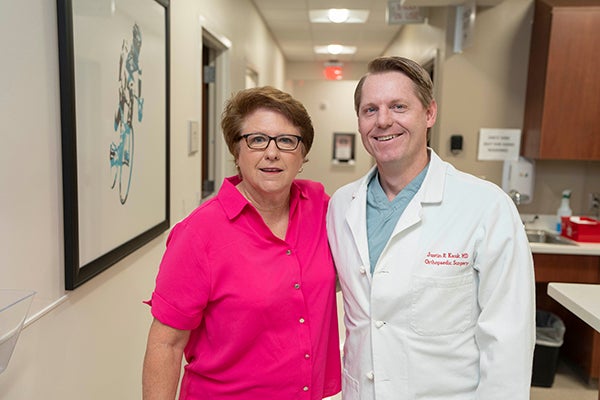
Freak accidents happen when we least expect them in the most unlikely places. Unfortunately, Nancy Campbell got to know firsthand what it's like to suffer a sudden, freak accident. Here is her story.
On April 16, 2024, Nancy went to her second floor attic, gaining entry through a bedroom and a bathroom.
"I was up there because a heating and ventilation company was coming to do maintenance on the heating and air conditioning unit."
Ninety-eight percent of the attic was floored and two percent was not.
"I was walking around trying to figure out the best place to put the ladder, so they could access the unit. I walked right onto the unfloored part and fell through."
Tumbling to a Surprising Drop
The first floor was 11 feet high, so Nancy fell about 12 feet. She landed on her left side and hit her kitchen granite countertop, shattering the edge into two distinct pieces. Her right leg made contact with the floor first, pulling her body down further.
"There were splinters and insulation everywhere, and I immediately thought I had broken my right ankle, which was swollen."
Realizing she still had her phone in her pocket despite the fall and that she could not stand up, she called her family for help. They came over immediately and called 911.
Uniting for Rescue in a Time of Crisis
Emergency medical services quickly and safely placed her on a gurney to transport her to WakeMed Cary Hospital Emergency Department.
Meanwhile, firefighters set about clearing the debris in her home — shattered granite, wood, insulation and more. They swept the floor and used sheetrock to cover the hole in the ceiling and floor.
"I was in awe of the firefighters putting my house back in order.
"One EMS worker kept asking me about my pain level, and I kept telling her it was only at a two or three. She was surprised I didn't need pain meds."
Discovering a Doctor with a Penchant for Putting Things Back Together Again
Nancy was taken directly to imaging for an ultrasound, computed tomography (CT) scan and X-rays. Soon, Wake Orthopaedics surgeon Justin Kauk, MD, arrived on scene and explained to Nancy that she'd not broken her ankle as she'd assumed.
He informed her that she'd crushed and broken the two tibia bones that ran down her right leg. He explained that she would need to cast the leg to immobilize it until she could have surgery the following day.
"With this procedure, the pain began to kick in as I was continuing to swell."
On April 17, Dr. Kauk performed a two-hour surgery, applying an external fixator to Nancy's leg as it was too swollen to perform the definitive procedure at the time.
"There were two pins poking up out of my shin. They probably came up a good three or four inches,. Another one was below my ankle all the way through my foot poking out on the other side. Several ace bandages were wrapped around the leg as well."
For the next two weeks, Nancy was non-weight bearing and was sent home into the care of loved ones.
Laughing, Nancy says, "They sent me home equipped like an 85-year-old. I had a portable bedside commode chair, a walker and a wheelchair."
One week after the surgery, Nancy had a checkup where they removed the ace bandages to look at her leg. Upon visually seeing her leg with three rods protruding out, she fainted.
"I couldn't handle it. I passed out cold. It looked as though I'd been impaled."
Before her upcoming surgery, Nancy had one final check-up. During the next assessment, she brought a tablet along and kept her gaze steady, avoiding looking down as they examined her injury.
 May 1, Dr. Kauk performed a second, two-hour surgery. This time, Dr. Kauk removed her external fixator and inserted plates and screws and cadaver bone into her leg to support the crushed joint.
According to Dr. Kauk, "When the tibia sustains an impact like she had when her foot landed, the joint surface or cartilage, is often impacted into the bone. To restore the joint, the cartilage needs to be returned to its native position. Once the cartilage is put back in place, a void is left. Often, cadaveric bone, provided by organ donors, is utilized to fill this space. It provides a scaffold, or foundation, to support the restored bone. It also helps the fracture lines to heal as the body incorporates the bone to rebuild the broken area."
Regaining Full Mobility Aided by WakeMed Physical Therapy
Following her definitive surgery, then began the long process of physical therapy twice a week for the next three months at WakeMed Physical Therapy – Cambridge Village.
"Once I went from mostly using a wheelchair to crutches, it felt funny where my leg connected with my foot. It was very sore. I think it was because I'd simply not used the muscles regularly for some time.
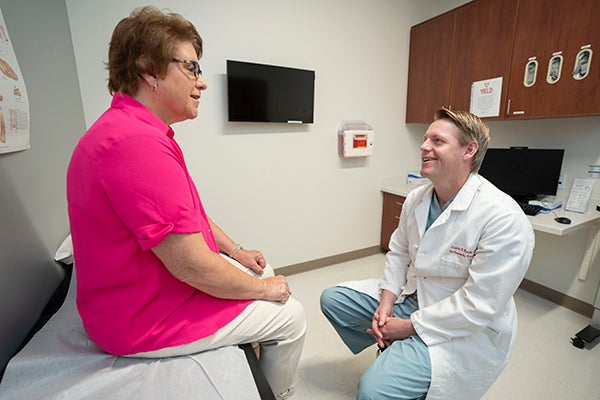
Three months after surgery, Nancy was cleared to be fully weight bearing, wearing a boot. She also obtained permission to use a knee roller for extended walking periods as well as drive.
"I stood up, and I just hugged Dr. Kauk's neck. He was probably like, 'Whoa. Wait a minute.' I was just so happy that I could finally drive. I couldn't contain my joy. I also loved my knee roller they gave me. I would fly down the grocery aisle. It really helped me get along much faster."
In February 2025, Nancy began feeling a little normal again.
"Since the injury happened in April 2024, it really took nearly a year for me to feel like myself again."
Dr. Kauk explains, "Nancy had one of the most severe injuries of the lower extremities that we see as orthopaedic surgeons. However, from the outset, she was determined to recover. I counseled her that even when we are able to piece the fragments back perfectly, there is still a risk of permanent stiffness and a limp. She replied, “That’s not going to be me!” She was right. What I remember most while caring for her was her positive attitude and determination. From day one, she was adamant that she was going to have a full recovery. She followed our recommendations exactly and put in the time and effort with physical therapy and on her own to reach her goals. I continue to be impressed with her resilience and optimism. It reinforces the importance of these characteristics in a patient’s recovery."
Expressing a Heart of Gratitude for Expert, Compassionate Care
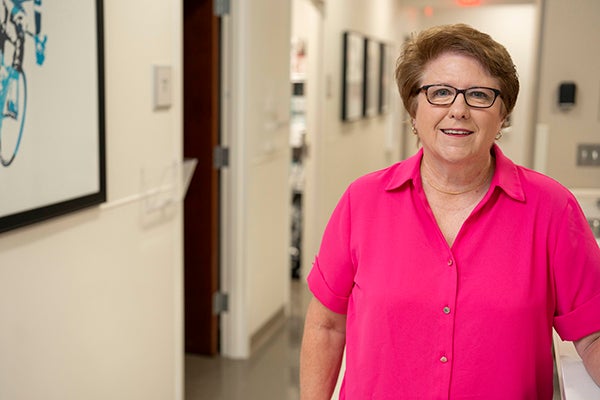
In reflecting on her surgical experience, despite periods of severe pain, Nancy is grateful.
"Dr. Kauk is one of the greatest physicians. I had an intuition about him that when he was a child he probably enjoyed playing with model airplanes and cars. Surprised when I told him about this, he readily agreed that I was correct. It's pretty obvious he likes to put things together. He has that knack for taking something that is messed up and putting it back like it was. Additionally, I ran into a nurse friend who knew I'd had both an external fixator and internal fixator with a plate and screw, and she told me that in her 40 years of nursing she'd never seen scars so small from that procedure. She was impressed. So this further proved to me he is the best of the best — five stars."
Nancy has been able to return to many activities she once enjoyed, including yard work and time in nature. She credits not only Dr. Kauk, but the entire WakeMed team.
"During my hospital admissions, the nurses and staff were so very nice and caring. It was just as smooth as it could possibly be. Everybody was just wonderful, including all the physical therapists who I got to see, obviously, quite a bit. Amir was an especially great physical therapist."
About Justin Kauk, MD
Dr. Justin Kauk is a board-certified, fellowship-trained orthopaedic trauma surgeon dedicated to restoring patients to pre-injury level of function through collaborative, high-quality care. His clinical interests include orthopaedic trauma and program development, streamlining processes to provide more cost-conscious and efficient patient care.
Dr. Kauk believes strongly in partnering with patients throughout their entire treatment and recovery process, working together to obtain an optimal outcome. In a collaborative approach, he and his patients identify the best treatment option for their injury. He strives to facilitate patient access to resources that impact healing and recovery following complex orthopaedic trauma including PTSD, addiction and food, housing and job insecurity.
Outside of work, Dr. Kauk enjoys spending time with his family, photography, biking, water skiing and snow skiing.
About Wake Orthopaedics
For more than 20 years, Wake Orthopaedics has been serving the Triangle community with comprehensive orthopaedic care to help their patients regain their mobility and restore their quality of life. With specialties and expertise in conditions of the bones, muscles and joints, our team of board-certified and fellowship-trained specialists utilize progressive treatments and state-of-the-art technology to care for everything from hip fractures to ACL injuries to arthritis. In addition to traditional orthopaedic services, Wake Orthopaedics provides trauma services, rehabilitation services and care for pediatric injuries. Wake Orthopaedics is a WakeMed Physician Practice.
About WakeMed Physical Therapy
It’s our goal at WakeMed Physician Practices – Physical Therapy to get you back to your active lifestyle. Our techniques are based on national best practices to ensure you receive the latest, best treatment for your condition. We provide physical therapy and occupational therapy in Raleigh, Cary, the Brier Creek area and Apex, North Carolina.