Jason Wilson: Navigating a Family History of Pancreatic Cancer and Receiving Expert Care from Surgeon Sam Chawla, MD
November 17, 2025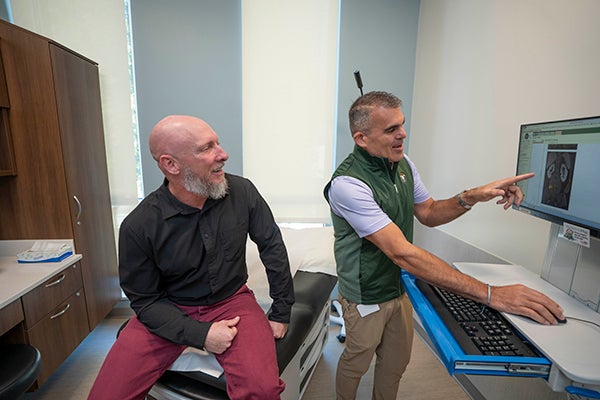
About Pancreatic Cancer
Per the American Cancer Society, about 10 to 15 percent of pancreatic cancers are likely influenced by genetic factors. Some families see a higher rate of disease, with up to 10 percent of those diagnosed having a family history of pancreatic cancer. Early detection is crucial, as it can significantly enhance survival rates — stage 0 cancers have a remarkable 93 percent 10-year survival rate, while stage I cancers offer a 34 to 39 percent chance of surviving for five years. Sadly, by the time symptoms arise, nearly 80 percent of patients are already facing advanced, inoperable stages of the disease.
Genetic testing can reveal mutations that increase the risk of pancreatic cancer. These tests target genetic conditions rather than the cancer itself. For those with a family history of pancreatic cancer, newer detection techniques, including endoscopic ultrasound and magnetic resonance cholangiopancreatography may offer valuable early screening options.
Fast forward to 2025: WakeMed clinical informatics specialist, Jason Wilson, had a family history of pancreatic cancer with devastating results.
"Three of my close relatives died of pancreatic cancer: my dad at age 56, uncle at age 57 and grandmother at age 84."
Pancreatic Cancer Screening for Those with a Genetic Predisposition
Jason knew that he could encounter the disease, but he was unaware that screening was possible — until a friend of his and his wife's whose mom was battling stage 4, non-operable pancreatic cancer, informed Jason that those with a significant family history could be screened for pancreatic cancer.
"I learned that as of 2021, gastrointestinal doctors stated that those with a heightened risk — which would involve a first generation relative and a genetic marker or two first generation relatives — could be screened 10 years earlier than the youngest relative's diagnosis. That meant I could be screened at 45. I was 47, so I scheduled an appointment with my primary care provider, Charles Williams, MD, for June 23. He referred me for a magnetic resonance cholangiopancreatography."
Jason's magnetic resonance imaging was scheduled for July 25, 2025, at WakeMed Imaging – Raleigh Campus.
Results that Sent Shockwaves
To his surprise, on July 28, he received his results, showing a renal mass.
"I didn't expect a renal issue. I had no urological symptoms. Yet, given my family history, I was 100 percent sure it was cancer because of the way it looked on the imaging. It was a 14.5-millimeter tumor on right kidney, consistent with a renal cell carcinoma mass that grew outward (exophytic). It was pretty small. Yet, it was highly enhanced, meaning there were a lot of blood vessels in it, which typically indicates a malignant tumor. I've been a nurse since 2009, so I knew the seriousness of my situation. It was around a three to seven percent chance that was not cancer. "
Reassurance and Hope with WakeMed Urology
With this sobering news, Jason was referred to Sam Chawla, MD, a WakeMed urologist. He spoke with him via telemedicine on July 30.
"I was very grateful for how the timing worked out with my appointment with the urologist because my wife was scheduled to go on a cruise with friends on July 30, and I wanted her to go. I didn't want her waiting around to see what was wrong with me. I talked her into going with the promise that our daughter, Aidan, who was a WakeMed Cardiovascular Intensive Care Unit (CVICU) nurse would attend the appointment with me to make sure all details would be shared with my wife. There was a chance, in this appointment, that I would receive devastating news of an inoperable cancer, so she was also my emotional support and the one who'd be able to discuss results with my wife."
During the video visit, Dr. Chawla pulled up a picture of the imaging and explained Jason's options.
Jason comments, "Dr. Chawla explained that biopsy was an option, but they did not prefer to do biopsies on these masses because of the potential of a false negative. Additionally, if they hit a live part of the tumor, they could spread the cancer when withdrawing the biopsy needle. He also offered cryotherapy where he would put a needle in the tumor and freeze it. The downside would be they would gamble as to whether or not all was frozen and removed. There would be no way to know until a rescan, which could potentially leave a cancerous tumor element growing in the body while awaiting the rescan. His third option was to do a partial nephrectomy where he would remove the tumor and a little extra to get the margins. The final and most radical option would be to completely remove the kidney, which was not recommended."
After listening to his options, Jason, without hesitation, decided on the partial nephrectomy.
"I told him, 'Say less because that's what I want you to do based on my research.'"
With this clarity, Dr. Chawla ordered a chest X-ray and complete metabolic panel for Jason to complete the next day on July 31. These would serve to check his labs and kidney function beforehand. They also discussed after-surgery lifting restrictions and how the recovery would go. Dr. Chawla told Jason he would spend one night in the hospital if everything went well.
Jason listened and then went to his follow-ups the next day where he had a great experience.
He remembers, "Danielle, the WakeMed Imaging manager, explained the walk-in process for my chest X-ray and ensured it went smoothly."
A Wait for Test Results
The multi-day wait for chest X-ray results was frightening for Jason. He feared he had cancer and relied heavily on his friends for support. They distracted him with dinner's out and talks. They encouraged him not to worry until there was something to worry about.
"I kept wondering why my results were taking long, in my opinion," says Jason. "I was told by Nicolle, the WakeMed Urology practice manager, not to worry and that the longer process for results was not because it was surely cancerous. She also ensured I was scheduled quickly and personally called to reschedule when a conflict arose. She provided her cell number for questions and even responded to my worried text about delayed chest results while serving jury duty — connecting me with a nurse on duty without hesitation. I quickly received a call from nurse Laura who explained the delay in radiology reads and reassured me that no results were being hidden. Her calm and informative approach helped dispel the terrifying self-diagnosis I had built over the weekend. Hyperfocused on the issue, I also reached out to the WakeMed Imaging manager, Danielle. She took time to explain the delays, helping to ease my mind."
On August 4, Jason received his results with an immediate and personal notification from nurse Heather who messaged Jason through MyChart once results became available. Before removing a renal mass, a chest X-ray is essential to check for any thoracic metastasis. This assessment not only aids in understanding the root causes of symptoms but also prioritizes patient safety. Additionally, it can help diagnose worsening conditions, such as fluid accumulation in the lungs.
Jason comments, "Her reassurance during one of the most anxious times of my life was deeply appreciated."
Plans for Surgery
Jason's surgery was scheduled for August 21 at 7 am.
With Jason's surgery date in place, Dr. Chawla offered to schedule an in-person visit, so they would meet before such a serious and invasive surgery.
Yet, Jason was assured of Dr. Chawla's reputation and was impressed with his bedside manner and knowledge during the video visit.
He recalls of that moment, "I said, 'Look, I do virtual meetings all day. I'm fine meeting you virtually. I'll shake your hand the morning of surgery as long as it's not shaking. I've been at WakeMed 15 years. I've already done my homework on you. I requested you specifically. I talked to a WakeMed clinical nurse specialist, two prior nurses and a manager as well as another manager who still works here. They each shared that if they needed a urological surgeon, it would be you, Dr. Chawla. They told stories of exceptional results that ranged from a husband's vasectomy to a dad's prostate cancer surgery. As far as I'm concerned, you're the man.'"
Hunger and Pain Calmed at WakeMed
On August 21, following the three-hour surgery at WakeMed Raleigh Campus, Jason went to his post-surgery room in the post-anesthesia care unit (PACU), where he was greeted by his wife. With his vitals strong, he was then taken to 5C to remain overnight.
Jason experienced very little pain, but he awoke extremely hungry.
"A nurse came in, greeted me, moved me and asked if I wanted anything before she left my room. I told her I was starving. She left and returned with cheese crackers, saltines and a Coke. I consumed all of it. Then a meal tray showed up. I ate 60 percent of that. I ordered my hospital dinner an hour later. I ate about 60 percent of that. My daughter called as she was on her way for a visit and asked if I wanted anything. I told her to bring me a big cookie and some chips. I ate every bit of that."
Jason also experienced challenges with movement after he awoke. He had seven laparoscopic sites, consisting of four incisions just under his rib cage down to his belly button. He also had three more small incisions on the right of his abdomen. Nurses offered him pain medications that helped him sleep through the night. They also assisted him with moving.
Jason shares, "I am in really good shape, yet I couldn't get around alone for a while after the surgery. It was hard to walk."
Jason was discharged home on August 22, and he was told to await the results of the mass removal to determine if it were cancerous.
Joyful Outcomes
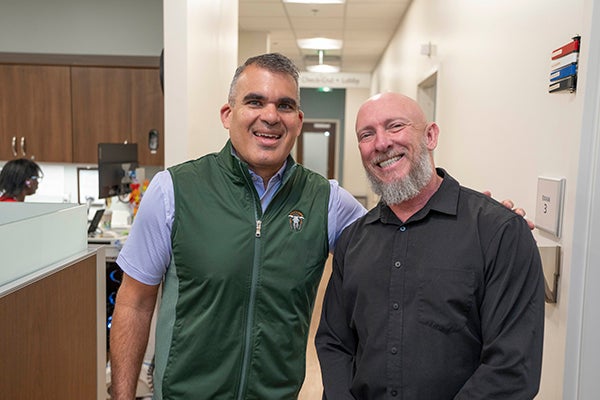
On August 27, Jason received his pathology results from the mass removal. Jason was cancer-free. Relief swept over him.
Laughing about the positive outcome, Jason shares, "I noted a shift in the care and attention that I was receiving from my wife. She was a great caregiver — bringing me food and doing all the wifely things. I found out at 4:45 pm that I didn't have cancer. At 6 pm, my wife said, "Don't you want to run and get us something to eat, and can you fill up my water bottle?"
Relieved and grateful, Jason gladly picked up dinner and got a billion-dollar Powerball ticket as well. He figured he was one lucky guy.
Dr. Chawla comments, "Given his young age and the favorable characteristics of the mass on imaging, I thought partial nephrectomy was the best option for Jason. The option offers very good cancer control with renal preservation. It was a pleasure to work with Jason. We were partners in his health care, and he was a wonderful teammate, asking very good questions. His outlook is positive."
Gratitude for the Most Exceptional Care
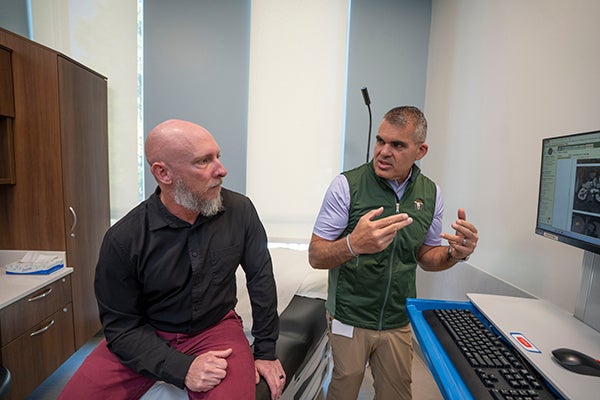
In remembering the gracious care of those who supported him emotionally and medically during that season, Jason offers words of thanks.
"Dr. Chawla was informative, reassuring and accommodating. He made time for a virtual visit on short notice and saw me in pre-op with warmth and humor. He was wearing a bracelet that sparked a lighthearted moment to help calm my nerves. As someone who reviews patient charts often, I was especially impressed by his impeccable pre-op note — it was so thorough. I felt I could have performed the surgery myself. I am also grateful to the many caregivers who watched over me. They didn’t just meet expectations — they embodied the WakeWay. Their actions reflected our mission, our culture and our commitment to treating every person with dignity, empathy and excellence. As a proud member of the WakeMed team, I’ve always believed in the values we stand for — but experiencing them firsthand gave me a renewed appreciation. I will never forget the care I received, and I am honored to work alongside such extraordinary professionals."
About WakeMed Imaging
WakeMed Imaging Services is a full-service imaging department offering advanced technology, convenient access and prompt testing and results. As professionals who have a true passion for care and caring, we focus on providing excellent, individualized service to each patient.
About WakeMed Urology
WakeMed Urology offers an outstanding team of urologists and urology surgeons who offer the most advanced urological services at locations throughout Raleigh, North Raleigh, Cary, and Garner, NC.